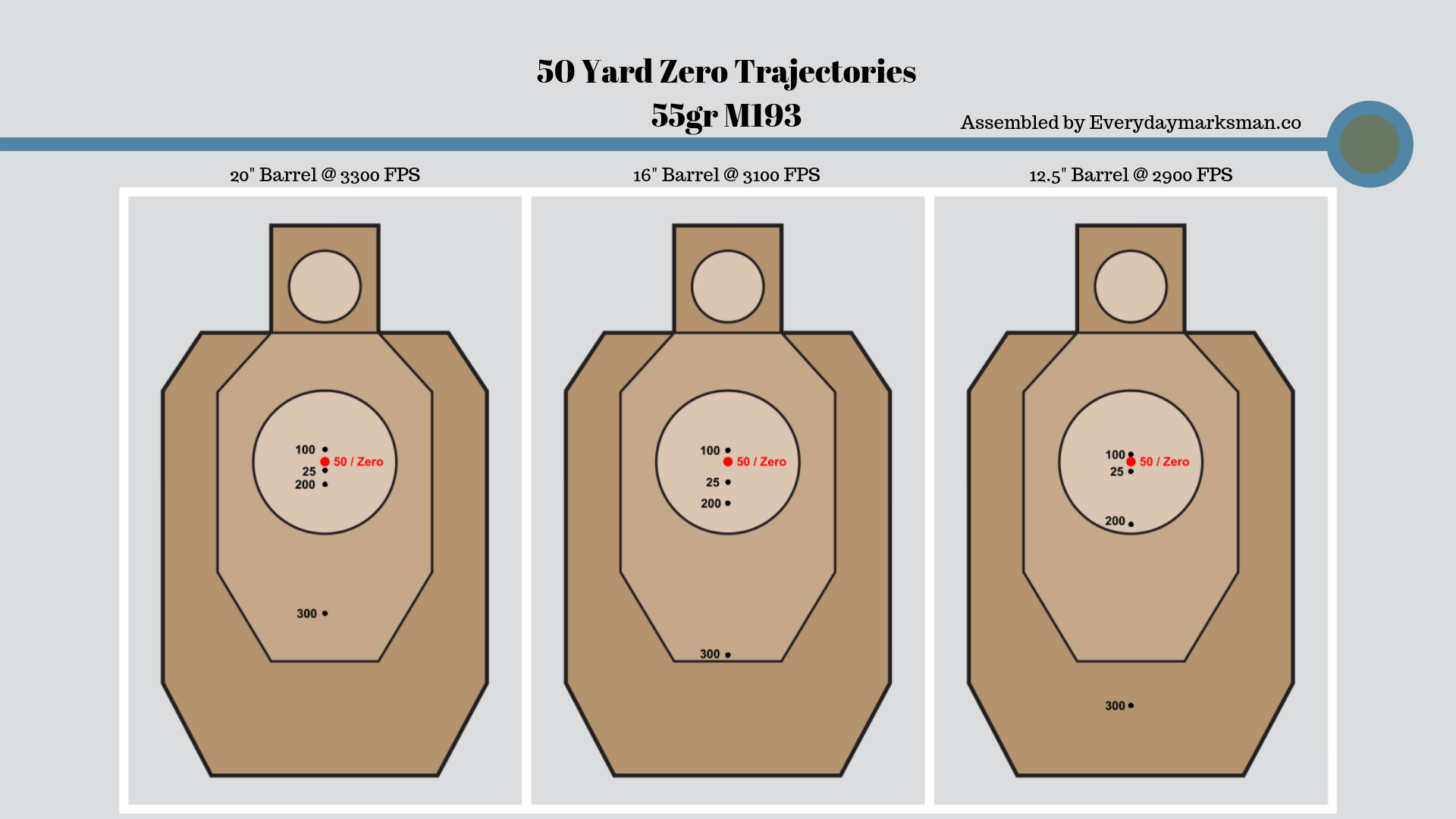
How to zero for 50 yards at 25 yards
If you sight your rifle at 25 yards for a 50 yard zero with a 5.56 55gr cartridge, your point of impact should be roughly 1.3 inches low at 25 yards, right on target at 50 yards, and approximately 2.6 inches high at 100 yards.
This is because the 50 yard zero creates a parabolic trajectory, which means that the bullet will rise above the line of sight as it travels to its maximum point before falling back down and crossing the line of sight again. By sighting in at 25 yards, you are effectively shortening the distance at which the bullet is traveling along this trajectory, which will cause the bullet to impact lower than the line of sight.
However, this is just a rough estimation and your specific firearm and ammunition may result in slightly different impact points. It is important to verify your zero and make any necessary adjustments before using your rifle in a shooting situation.
If my gun is sighted in at 100 yards, where will it hit at 50 yards?
If your .223 rifle is zeroed at 100 yards with a typical 55-grain load, it will usually hit a little high at 50 yards, because the bullet is still rising toward the line of sight at that point. With common setups, think roughly about 0.5 to 1.5 inches high at 50 yards, depending on your sight height over bore, muzzle velocity, and the exact ammo. The key detail people forget is sight height: your optic or irons sit above the barrel, so at very close range you’ll hit low, then the trajectory crosses up toward the aiming line and continues climbing until it peaks and starts dropping back down to meet your 100-yard zero. Bottom line: at 50 yards, expect a modest high impact, but don’t bet your life on an exact number without confirming with your specific rifle and load.
If my gun is sighted in at 50 yards where will it hit at 100 yards?
If your .223 rifle is zeroed at 50 yards with a typical 55-grain load, it will generally hit low at 100 yards because the bullet has already crossed the line of sight and is dropping by the time it gets there. With most 55-grain .223 setups, expect roughly 1.5 to 2.5 inches low at 100 yards, depending on muzzle velocity and your optic’s height over bore. This is why a 50-yard zero is popular for close-range work: it keeps impacts tight and predictable inside 100, but you pay for that simplicity with noticeable drop as distance increases. Translation: at 100 yards, you need to hold a little high if you’re running a true 50-yard zero.